Unearthing a Legacy.

Dig Mitchelville is the official, publicly accessible digital archive of archaeological and historical research at Historic Mitchelville Freedom Park.

Funded in part by Alice L. Walton Foundation

Archaeology Collections

Since the 1980’s, archaeologists have been uncovering the stories buried beneath Historic Mitchelville Freedom Park—the first self-governed town of formerly enslaved people in the United States. From the pioneering work of the 1980s to recent community-engaged excavations, each project has added crucial pieces to our understanding of this sacred ground where freedom, democracy, citizenship, and opportunity first took root for Gullah Islanders.

1980’s The Chicora Foundation

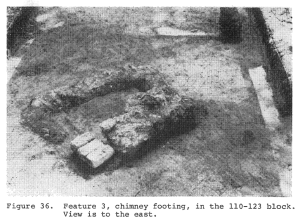
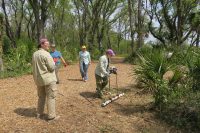
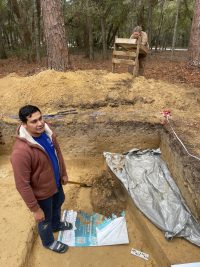
In the 1980’s The Chicora Foundation did the first archaeology work in what would become Historic Mitchelville Freedom Park : This is a photograph from

Remote Sensing Begins

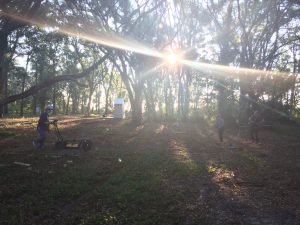
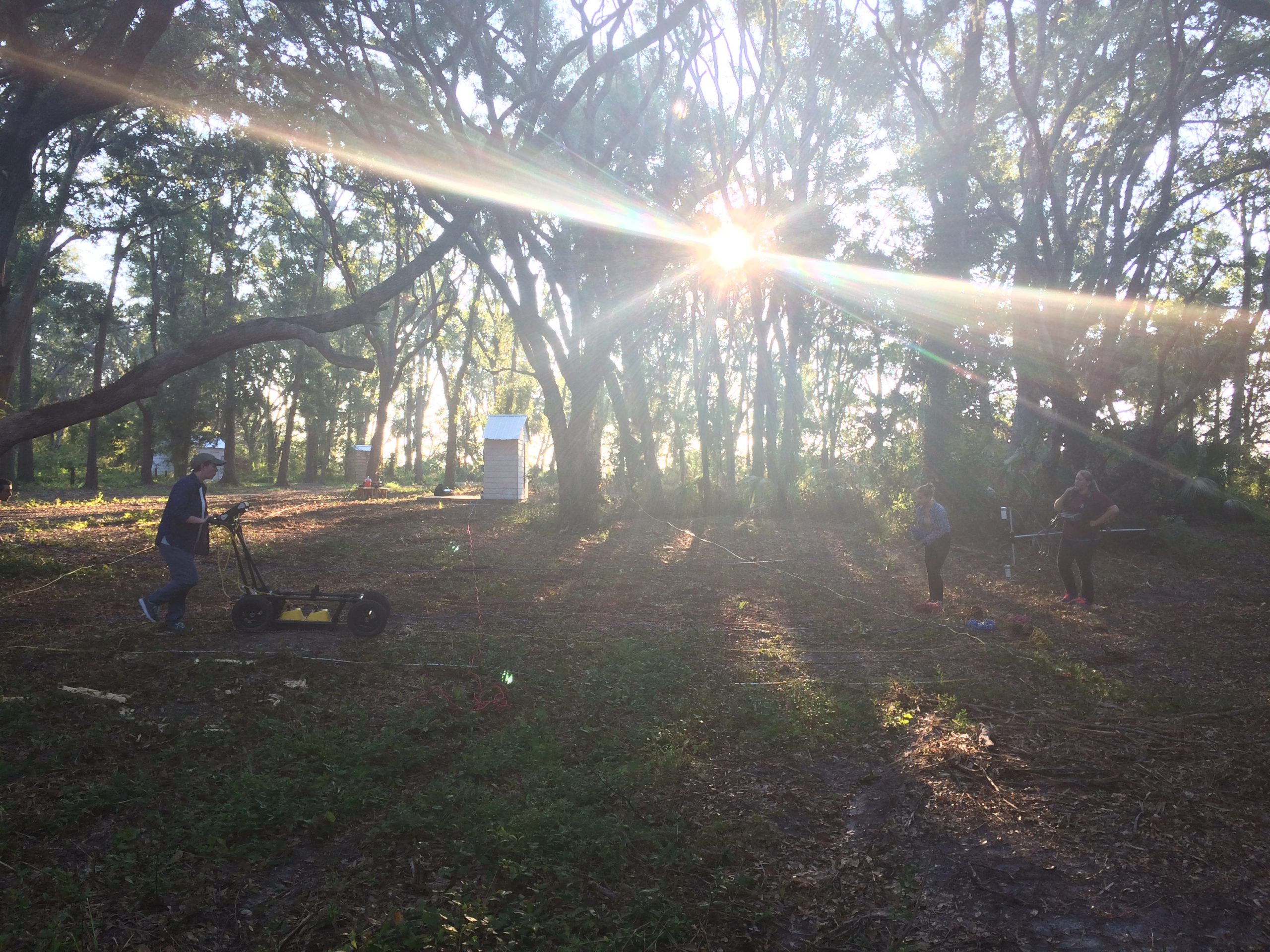
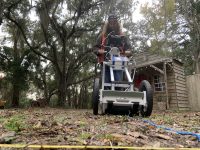
Binghamton University Students take first Ground Penetrating Radar scans of the park. They were hoping to find evidence of the first church or Praise House. 

Mitchelville’s First Church

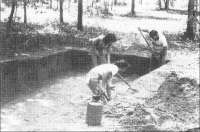
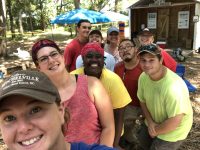
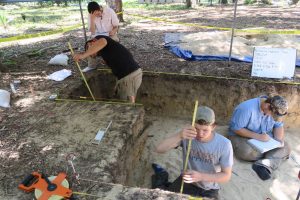
Search for Mitchelville’s First Church: After using Ground Penetrating Radar to narrow down where the first Church or Praise House might have been, Binghamton Students

Explore the Findings

1980s–1990s

Foundation Work

Led by: Chicora Foundation (Michael Trinkley)
Significance: Established Mitchelville’s archaeological importance, leading to National Register of Historic Places listing in 1988
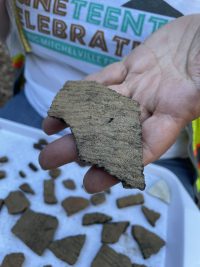
The archaeological story of Mitchelville began when construction work accidentally uncovered Native American artifacts near Coggins Creek. The Chicora Foundation’s archaeologists found over 25,000 artifacts from Mitchelville-era deposits, including Mitchelville homesites with intact hearths. This foundational work proved that Mitchelville residents were participating in a cash economy and acquiring higher status goods than they had previously owned during enslavement.
Key Discoveries:
  • Four major structural complexes excavated
  • 25,000+ artifacts recovered
  • Evidence of both indigenous Late Archaic occupation and Reconstruction-era Mitchelville
  • Proof of residents’ improved material conditions post-emancipation
1980s–1990s: Foundation Work
2017

Remote Sensing Begins

Led by: Dr. Katherine Seeber (Binghamton University)
Focus: Initial ground penetrating radar survey
The modern era of archaeology at Mitchelville began with a small ground-penetrating radar survey to test the effectiveness of the equipment in the park’s unique soil conditions. Although this initial work didn’t produce a large amount of data, it laid the foundation for future remote sensing strategies.
2017: Remote Sensing Begins
2018

Search for Mitchelville’s First Church

Led by: Dr. Katherine Seeber
Focus: Remote sensing and excavation to locate the first church or Praise House
Using magnetometry and electrical resistivity, undergraduate and graduate student archaeologists identified places under the ground that were most likely to have evidence of a past building that led to targeted excavations. That summer, a field school (or summer archaeology class) worked to excavate areas around the old Praise House exhibit and worked hard to build relationships with local community members who came to visit the excavations.
Project Highlights:
  • Remote sensing survey using magnetometry and electrical resistivity
  • Community-based participatory research approach
  • PhotoVoice documentation of the archaeological experience
  • Complete documentation available in digital archive
2018: Search for Mitchelville’s First Church
2019

Data Recovery and Community Engagement

Led by: Dr. Katherine Seeber
Focus: Expanded excavations and visitor survey program
Archive Coming Soon
Building on 2018 discoveries, archaeologists expanded excavation areas and implemented the first visitor survey program to understand how different communities connected with Mitchelville’s story. This work also included ethnographic interviews with multi-generational Gullah Geechee islanders. The project recovered hundreds of Mitchelville era artifacts and strong evidence of a building footprint.
Project Highlights:
  • Extended excavations in multiple operations
  • First visitor survey program implemented
  • Ethnographic interviews with community elders
  • Evidence of both Mitchelville and indigenous Late Archaic occupation
2019: Data Recovery and Community Engagement
2020–2021

Remote Sensing Revolution

Funded by: National Trust African American Cultural Heritage Action Fund
Focus: Park-wide remote sensing assessment
Archive Coming Soon
The COVID-19 pandemic shifted focus to comprehensive remote sensing across the entire park. This $50,000 matching grant project aimed to assess all heritage resources before any development, establishing HMFP as a leader in heritage preservation planning.
Project Significance:
  • First comprehensive park-wide archaeological assessment
  • Integration of advanced remote sensing technologies
  • Foundation for sustainable heritage management planning
  • Model for other historical sites nationwide
2020–2021: Remote Sensing Revolution
2023–2024

Visitor Center Preparation

Led by: Dr. Katherine Seeber
Focus: Phase 1 surveys for future Visitor Center construction
Archive Coming Soon
Archaeological investigations continued as HMFP prepared for construction of their new Visitor Center. These surveys ensured that all significant archaeological deposits would be properly documented and preserved before any development.
Project Focus:
  • Systematic survey grid implementation
  • Artifact density mapping
  • Preparation for major excavation phases
  • Integration with architectural planning
2023–2024: Visitor Center Preparation

Lorem ipsum dolor sit amet, consectetur adipiscing elit. Ut elit tellus, luctus nec ullamcorper mattis, pulvinar dapibus leo. Lorem ipsum dolor sit amet, consectetur adipiscing elit. Ut elit tellus, luctus nec ullamcorper mattis, pulvinar dapibus leo. Lorem ipsum dolor sit amet, consectetur adipiscing elit. Ut elit tellus, luctus nec ullamcorper mattis, pulvinar dapibus leo.

FAQ

Lorem ipsum dolor sit amet, consectetur adipiscing elit. Ut elit tellus, luctus nec ullamcorper mattis, pulvinar dapibus leo. Lorem ipsum dolor sit amet, consectetur adipiscing elit. Ut elit tellus, luctus nec ullamcorper mattis, pulvinar dapibus leo. Lorem ipsum dolor sit amet, consectetur adipiscing elit. Ut elit tellus, luctus nec ullamcorper mattis, pulvinar dapibus leo.

What was Historic Mitchelville?

The first self-governed town of formerly enslaved people, established in 1862 on Hilton Head Island, South Carolina.

All findings are shared through this free digital archive and our social media @digmitchelville.

Follow @digmitchelville or contact Dr. Seeber for event announcements and registration.

Yes! Our community events welcome all experience levels with professional archaeologist guidance.